 Johannesburg Travel Guide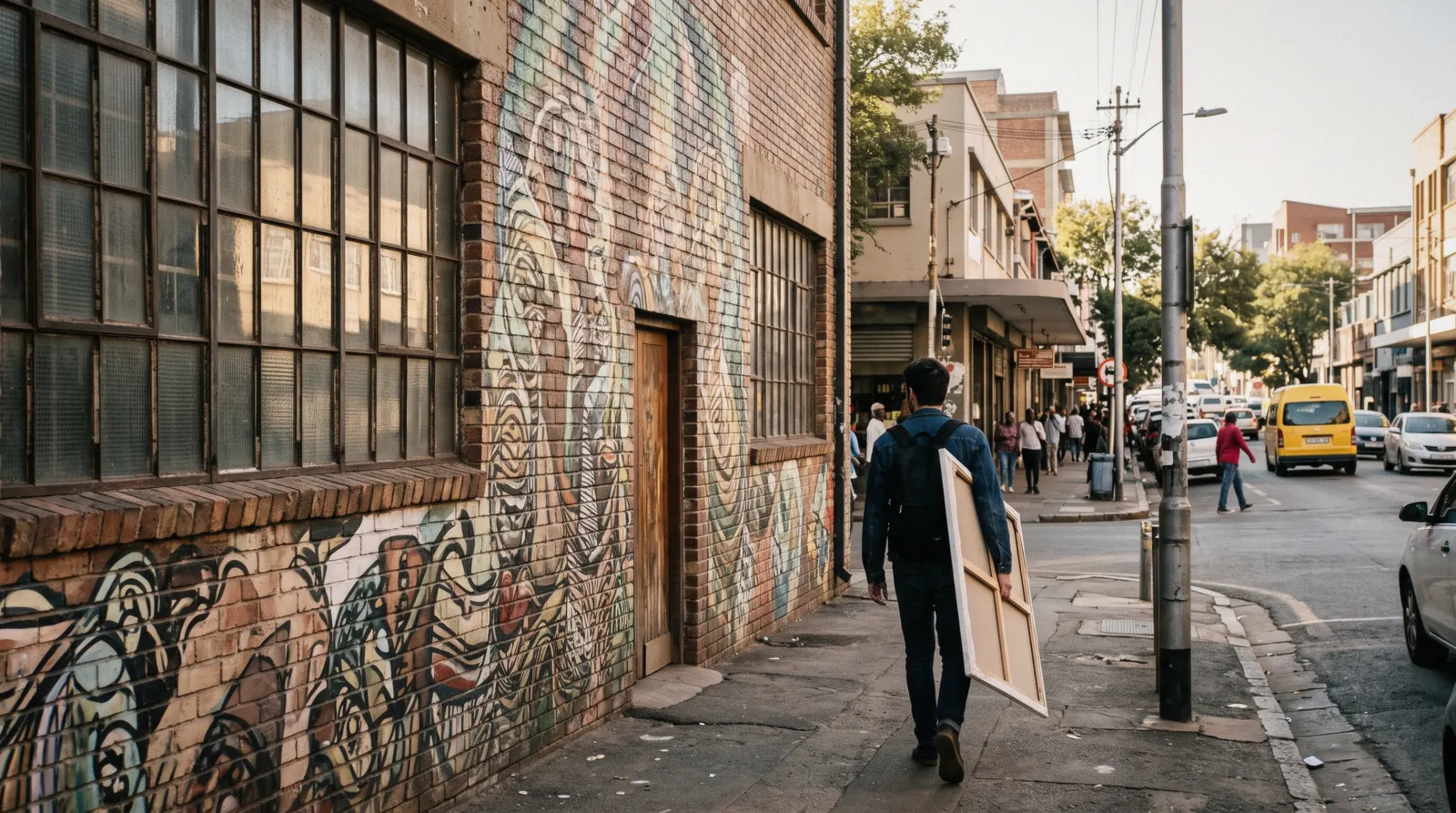
The Maboneng precinct has been regenerating on the south-eastern side of Johannesburg's inner city since 2009 — Sesotho for 'place of light', a name the precinct gave itself when developers began retrofitting a run of manufacturing blocks east of the CBD. This page covers what actually stands there now: the redevelopment story including the honest status of Arts on Main, the street art that made the precinct famous, the Sunday rhythm that the precinct's own site calls its busiest, where to eat, and the safety frame every visitor should plan around — walkable core by day, e-hail after dark. The practical alternatives next door are on the Newtown guide and the Braamfontein guide.
Quick answer Where it is, what it costs, the Sunday market and the night rule
Maboneng is a regenerated precinct of retrofitted manufacturing buildings about 1.2 kilometres east of the Johannesburg CBD's core, free to walk in daylight, with more than fifty street-art pieces on its walls and its biggest day on Sunday, when Market on Main draws the crowd. The one booking worth making is the two-hour street-art walk, listed at $37.64 — and after dark you e-hail in and out rather than walk.
Key takeaways
- The walls are the sight: the guided street-art and culture walk runs two hours and adds the artists' stories the murals only hint at.
- Sunday is the day the precinct was built for — the Sunday stride has the shape of it, and the market question answered honestly.
- The safety frame is simple: core by day, e-hail after dark — the sourced version is in the night section, and the wider picture on safety and scams.
Day versus evening in the precinct
The precinct is two different places twelve hours apart, and planning the wrong one is the common mistake. The table splits what each half of the day does well, from the precinct's own descriptions of itself and the foreign office's after-dark rule.
| What | Daytime | After dark |
|---|---|---|
| Streets and murals | The whole point: 50-plus pieces readable on foot, cafes and studios open | Walls unreadable, streets thin — do not stay out for them |
| Food and market | Cafes and lunch counters inside the core; Sunday draws the market crowd | Restaurant evenings work — arrive and leave by e-hail, door to door |
| Tours | The street-art walk runs in daylight — book a morning slot | No visitor should be walking here at night; the night formats belong to Soweto |
| Getting there | E-hail from the northern suburbs in minutes; walkable from the CBD grid | E-hail only, and to the specific venue's address — never 'Maboneng' as a destination |
The evening column is deliberately stricter than the precinct's marketing: the UK foreign office advises against walking anywhere in the city after dark, and the precinct's own crowd thins outside event hours.
The walks that unlock the precinct and the city
Two cards: the precinct's own street-art walk, and the city-centre walk that ends within e-hail range of Maboneng — the honest pairing for a day on this side of the inner city. Prices and ratings are the platforms' own dollar listings in Q3 2026; the precinct itself charges no admission, so there are no rand figures to convert here (site rate, for reference: $1 = R16.30).
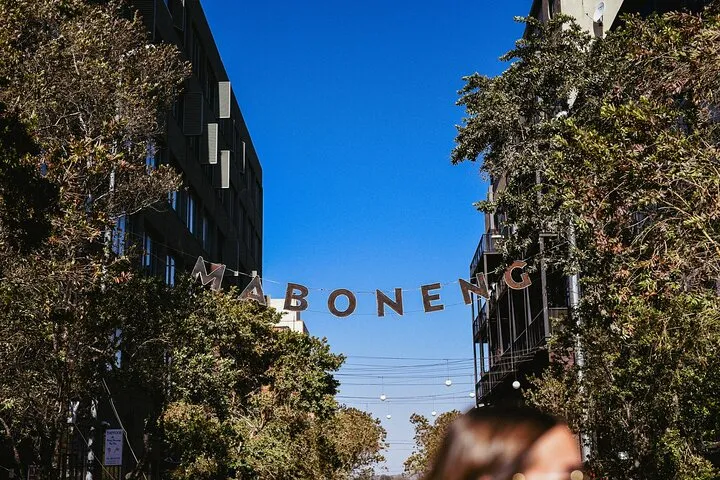 from $37.64
Johannesburg: Maboneng Street Art & Culture Tour
Maboneng's murals and redevelopment story on foot with a local host.
Check Availability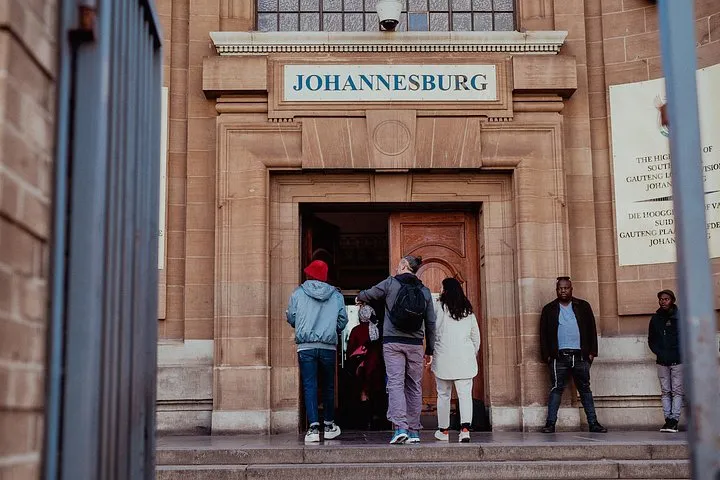 from $49.29
Johannesburg City Centre Walking Tour
The CBD grid on foot: mining headquarters, art deco towers and the quiet corners visitors never find alone.
Check AvailabilityPrices, ratings and details are the platform's own. dollar figures are the listed prices — the platform bills in your account's currency.
What the Maboneng precinct is, and where it sits
Maboneng is a Sesotho word meaning 'place of light', and the precinct that took the name occupies a run of city blocks on the south-eastern side of Johannesburg's inner city, where manufacturing buildings and warehouses have been retrofitted into apartments, studios, galleries, restaurants and retail. On the map it is closer than it feels: the precinct's centre sits about 1.2 kilometres east of the CBD's core, a straight line from the Carlton Centre end of the grid — but the railway lines and the discontinuous streets between mean visitors arrive by e-hail far more often than on foot.
The name came with the project: a 2009 public-art installation, Remote Words, curated with the writer Niq Mhlongo, put the word on the buildings, and the precinct kept it. That is worth knowing before you read the walls — the precinct has always been part real place, part story told about itself, and the honest guide's job is to keep the two separate. The story is on the precinct's own site; the streets are on the ground, free to walk in daylight, and busiest by far on Sundays.
The name trap worth a line: maboneng.com is a different operation — a township-arts tour operator — not the precinct. Book walks through the cards on this page or turn up, and for the precinct's place among the city's other districts, the neighbourhoods hub is the routing layer of the Johannesburg travel guide.
The redevelopment story, 2009 onward
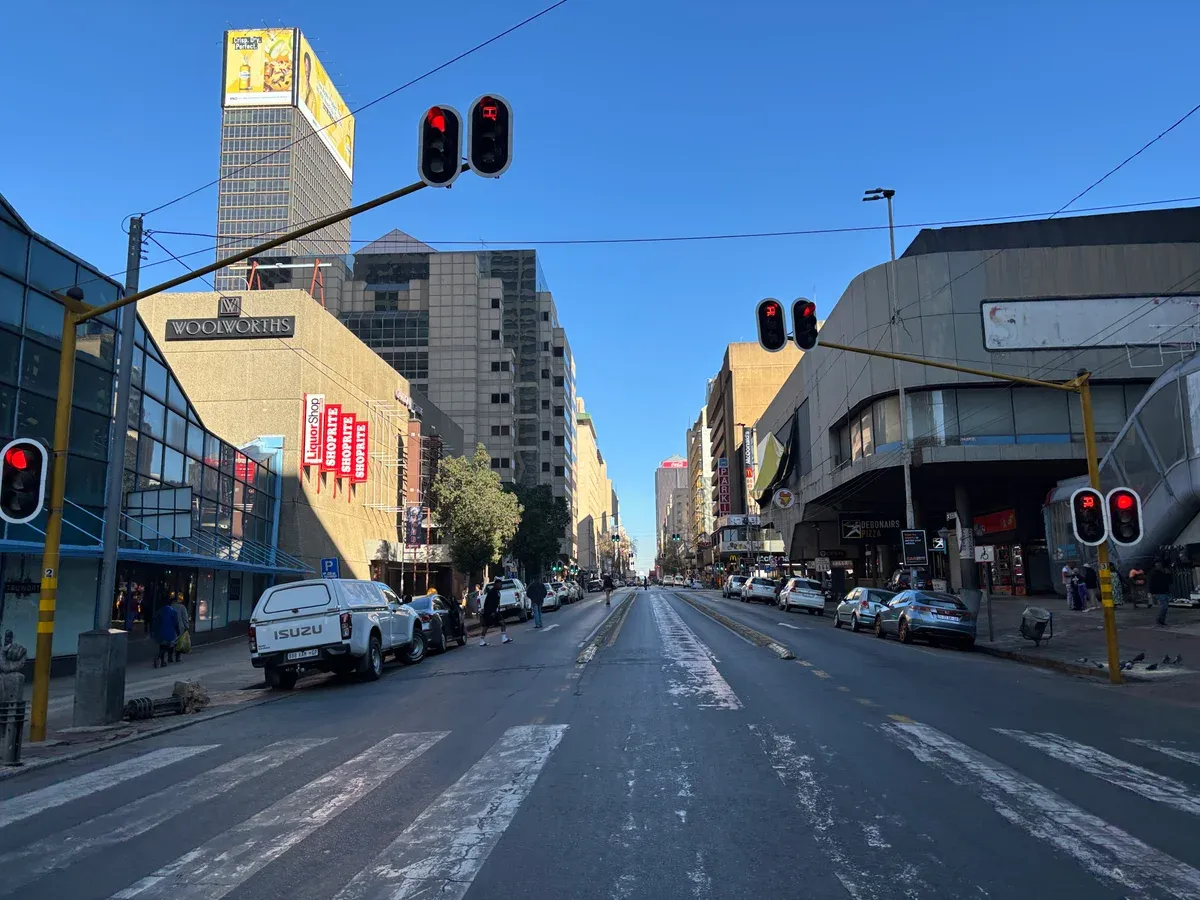
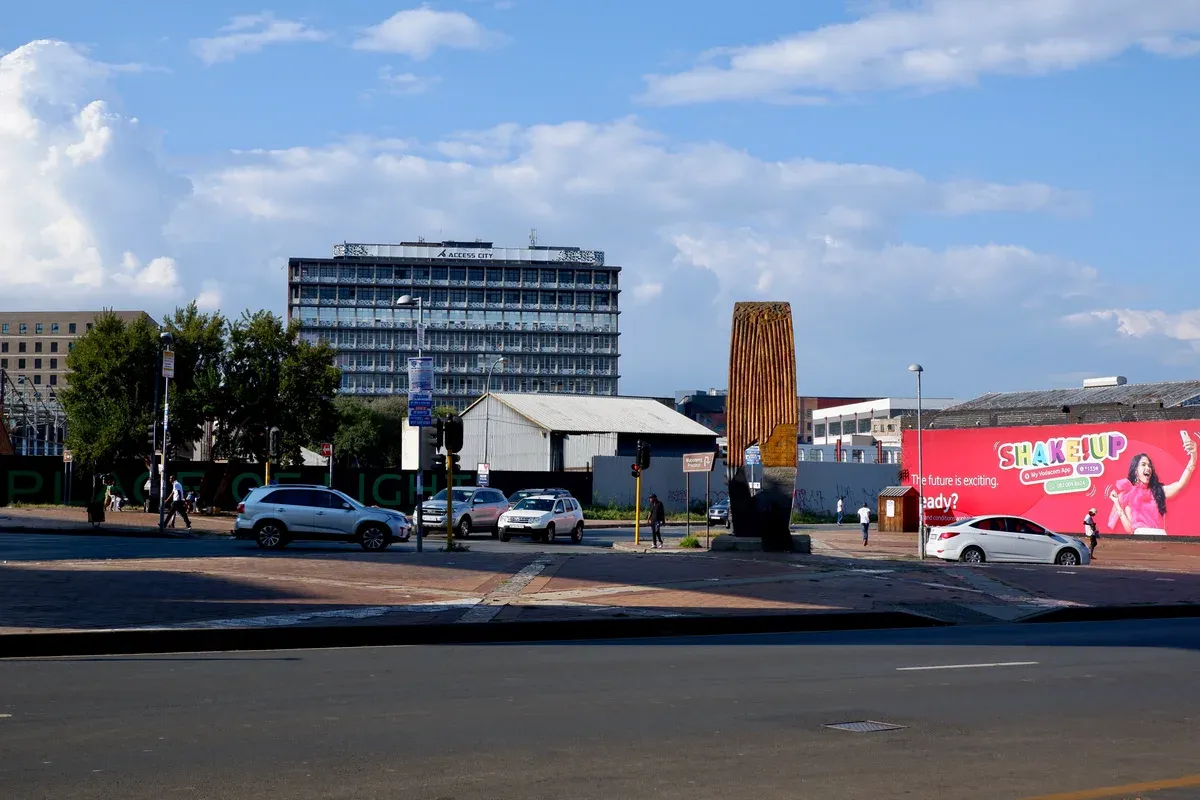
Commissioner Street in the inner city — the old commercial spine the precinct's retrofitted blocks face. Photo: Nick-D, CC BY-SA 4.0, via Wikimedia Commons
The precinct begins with one building: Arts on Main, at 264 Fox Street, redeveloped in 2009 by the company Propertuity as a mixed-use creative hub — artists' studios, galleries, workshops and eateries behind a factory facade. From there the precinct grew building by building: by the mid-2010s it counted more than fifteen redeveloped mixed-use blocks and had become one of the most-photographed experiments in inner-city regeneration anywhere in Africa, documented in the street-photography of Martha Cooper among others.
Two honest caveats belong in any telling. First, the broader precinct has always been uneven: the retrofitted core is a few blocks, and the streets beyond it are ordinary inner-city Johannesburg — the precinct's boundaries are a marketing line as much as a planning one, so treat 'Maboneng' as the core and not the postcode. Second, Arts on Main itself: its own site is still live with no closure notice and still describes the studios-galleries-eateries mix, but it publishes no opening hours and no explicit 'open' statement — so print no hours here, and check the building's doors on the day if it is the specific reason for your visit.
The regeneration also had its critics — rising rents and the displacement questions that follow every precinct like this one — and the honest version of the story includes them. What the visit shows you is the experiment still standing: occupancy, murals maintained and repainted, and the Sunday crowd that pays for all of it.
The street art: what is on the walls, and who put it there
Painted work on a median wall in the precinct — the walls change, the density does not. Photo: Gsalamander, CC BY-SA 4.0, via Wikimedia Commons
More than fifty street-art pieces sit across the precinct, and the ones that made its name arrived through I Art Joburg, the 2012 project that brought five internationally known muralists into the neighbourhood: Steve Espo Powers, whose typographic 'Stay Up' still greets the precinct; Roa, the Belgian known for black-and-white animals; Falko, South Africa's graffiti elder; Remed, whose 'Remed's View' building became a students' residency; and Cameron Platter. The Chinese artist DALeast painted 'Creature', his wireframe beast, on the Maverick Corner building; Hannelie Coetzee set a mosaic of two 1940s aunties — her own grandmother and great-aunt — into a Commissioner Street wall, from a photograph taken on that same street; Nelson Makamo painted a street-length line of children on Van Beek Street. Shepard Fairey and the South African Faith 47 added pieces later in the same wave.
Two practical notes. The walls change: pieces get painted over, refreshed and replaced, so any list — including this one — is a snapshot, and the precinct's own line is that the street art 'constantly changes the face' of the neighbourhood. And the guide question: the precinct is fine to wander alone by day, but the two-hour street-art walk, listed at $37.64 and rated 4.89 from 187 reviews, adds the artists' names and the precinct's story to walls that only hint at both — the highest-leverage two hours you can spend here.
The Sunday stride
The precinct's own site is blunt about its rhythm: 'Sundays are our busiest day as Market on Main draws the crowd.' The Sunday shape of a visit writes itself — arrive mid-morning, walk the murals while the light is flat and the streets quiet, then let the day fill toward the market and lunch, and finish on a rooftop or a square bench while the crowd does its afternoon lap. By late afternoon it thins fast, and the precinct returns to its weekday self.
The honest caveat, printed because this site prints caveats: neither the market's hours nor an entry fee is published on any official channel checked for this guide. The market is real, the Sunday crowd is real — the precinct names the day itself — but the opening time is not something we can print from a source, so plan the morning around the murals and let the market be the destination you arrive at rather than the appointment you race.
Weekdays trade crowd for calm: the walls are emptier of people and better for photographs, the cafes run a normal service, and the studios keep working hours — but nothing like the Sunday energy. If you have one day and it is not a Sunday, go anyway; if you have the choice, the two-day plans that put Maboneng on a Sunday are built on exactly this logic.
Eating in the precinct
The precinct's own description of itself — restaurants, coffee shops, clothing boutiques, art galleries, retail — is the honest menu: this is a cafe-and-restaurant precinct, not a dining destination with reservations to chase. The reliable plan is to eat inside the core where the foot traffic is, book nothing, and let the Sunday market meal be the one you plan the day around. Venue turnover here is high — names change faster than any printed list — so treat this page's refusal to name a dozen restaurants as diligence rather than thinness.
Two anchor points do hold. Coffee and breakfast inside the core before the murals is the precinct's own morning ritual, and on Sundays the market is the eating event, with the food stalls doing the cooking for the whole neighbourhood. For the serious eating research — the city-wide list, the streets where restaurants cluster, what a meal costs — the running list lives on where to eat in Johannesburg; and if you would rather be fed through a neighbourhood with a guide, the street-food walk two districts west in Fordsburg is the city's best-established eating tour — the details are on where to eat in Johannesburg.
The safety frame: core by day, e-hail after dark
The frame in one sentence: the precinct's retrofitted core is genuinely walkable in daylight, and after dark you move by e-hail — venue address to venue address — because the UK foreign office's advice for South Africa says plainly not to walk around after dark, and the precinct's streets thin to venue crowds at night exactly like the rest of the inner city. Some specifics that make the frame work. Arriving, order the car to a named address or a named corner inside the core rather than to 'Maboneng' — the precinct's edges are ordinary inner-city blocks, and the difference between a good corner and a bad one is one crossing.
Between venues at night, the thirty-metre walks are fine; the ten-minute ones are not the move. Phone out of sight at crossings, the same discipline as any big city. And the load-shedding note, named once: national load-shedding has not run since May 2025, but Eskom's localised 'load reduction' still cuts supply to a few percent of customers, mostly in Gauteng — so a dark traffic light on the drive home is infrastructure, not an omen.
The wider picture — what the advisories actually say, the scam patterns, which formats (guides, e-hail, tours) close the gaps — is on safety and scams, and the Hillbrow district next door is the case study in why the frame matters.
The precinct on the map
The precinct core with its connectors: the CBD end of the walking route, the two inner-city neighbours, and the tower district between them. Distances in the notes are straight-line from the precinct pin.
- 1 Maboneng coreThe retrofitted blocks: murals, cafes and studios, free to walk by day; busiest on Sundays.
- 2 Arts on Main, 264 Fox StreetThe first redevelopment, 2009 — site live with no closure notice, but no published hours; check the doors on the day.
- 3 The CBD gridAbout 1.2 km west: the city-centre walking tour's ground, and the honest walking route in by day.
- 4 NewtownRoughly 2.3 km west: the market precinct, the Market Theatre and the square.
- 5 BraamfonteinRoughly 2 km north-west across the rail lines: the student ridge, the free museum and Constitution Hill.
Numbers match the pins on the map.
The Arts on Main pin sits at the published 264 Fox Street address; the other pins are the district centres used across this site.
Next district from the precinct
The market precinct, west
The Market Theatre, Mary Fitzgerald Square and the mine-rail heritage: the Newtown guide.
About 2.3 km west, one e-hail Read the guideThe student ridge, north-west
The free Wits Art Museum, Constitution Hill and the bridge: the Braamfontein guide.
About 2 km, one e-hail Read the guideThe tower district, between
Ponte City's hollow tower on a small guided visit — the view over everything on this page: the Ponte City guide.
About 1.5 km north, booked visit only Read the guideMaboneng: questions
Which part of Johannesburg is Maboneng in?
The inner city: the precinct sits on the CBD's south-eastern side, its retrofitted manufacturing blocks about 1.2 kilometres east of the city centre's core — close enough to reach on foot from the CBD grid in daylight, far enough that most visitors e-hail in.
What is there to do in the Maboneng precinct?
Walk the mural walls — more than fifty pieces, the reason the precinct is famous — eat and drink in the retrofitted core, and take the two-hour street-art walk if you want the artists' stories. The Sunday market is the week's event, by the precinct's own description of its busiest day.
Is there a market in Maboneng on Sundays?
Yes — Market on Main is the precinct's Sunday institution, and the precinct's own site names Sunday as its busiest day because of it. What no official channel publishes is the market's hours or an entry fee, so treat it as a destination to arrive at midday rather than an appointment with a printed time.
Can you walk around Maboneng at night?
Between venues, yes; as an activity, no. The foreign office's advice is not to walk around after dark anywhere in the city, and the precinct's streets thin to venue crowds at night. The working pattern is e-hail to the door, and e-hail out — the safety frame has the details.
Is the Maboneng precinct worth visiting?
For the murals and the Sunday energy, yes — it is the single most walkable district in the inner city by daylight, and it costs nothing. Manage two expectations: the precinct is a few retrofitted blocks inside an ordinary inner-city neighbourhood, not a walled attraction, and Arts on Main no longer publishes hours. The redevelopment story has the honest version.
How do you get to Maboneng from the northern suburbs?
By e-hail — roughly twenty minutes outside peak, ordered to a named corner inside the precinct. The Gautrain does not serve the precinct; its nearest logic is Park Station on the CBD's edge, then a short car. Coming from the airport, the train to Sandton plus a car, or one car the whole way.
The precinct on film
Three filmed passes through the precinct — a recent walk-through, the development story, and the honest safety-question video every visitor should watch before deciding their hour.
Is South Africa Rising? Exploring Maboneng, Johannesburg
A recent walk through the precinct's streets and redevelopments — the ground this page describes.
Video: AfricaTrekkSouth Africa | Maboneng, Johannesburg | 4 April 2026
A 2026 street pass, current enough to show which walls and corners look like this now.
Video: Studio28 - South AfricaMABONENG JOHANNESBURG, IS IT SAFE? | Travel Vlog | STREETS
The safety question asked on the ground — watch it against the safety frame above rather than instead of it.
Video: ishowLifeVideos load from YouTube only when you press play.
Prices, hours and terms are set by the venue or operator and confirmed at checkout.
We may earn a commission if you book through one of our links, at no extra cost to you. Full affiliate disclosure