 Johannesburg Travel Guide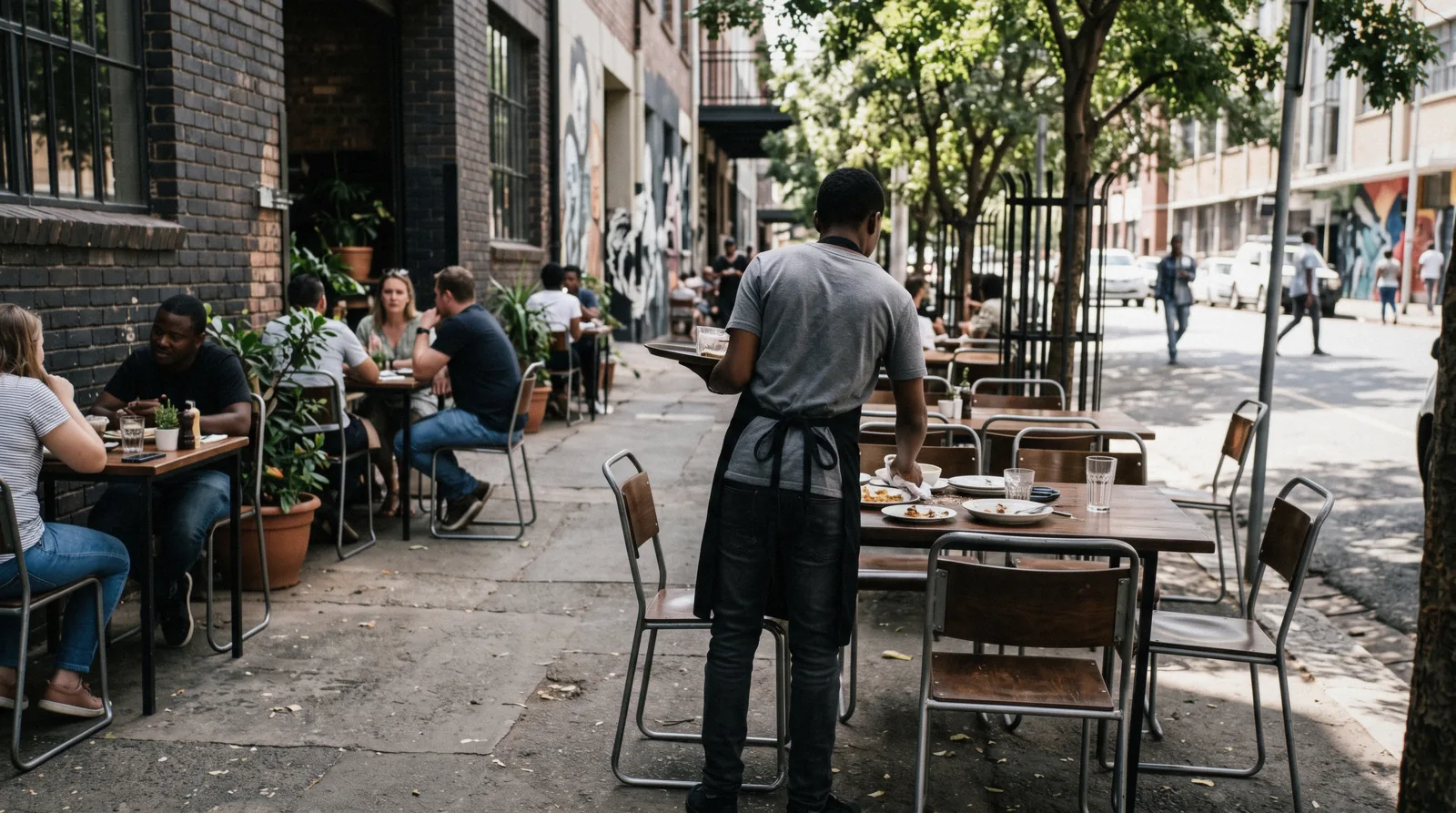
Where to eat in Johannesburg is a question of areas, not of a ranked list of restaurants: the city eats in at least four distinct economies — township kitchens, inner-city market halls, student strips and mall terraces — and they open, price and close by different rules. This page maps the areas, explains the money honestly, and hands the first bite to a guide where that genuinely helps. The dishes themselves have their own page: what to eat.
Quick answer Four eating economies, and where each one fits a day
Eat by area and by hour. The township kitchens of Soweto are a guided day-trip lunch — the walk that eats with a local costs $43 and rates 4.9 from 823 travellers. The market halls of Maboneng are a Sunday-morning thing. The Braamfontein strip is a daylight museum-day lunch. The Sandton and Rosebank mall terraces are the reliable dinner, with printed menus that already include the 15% VAT — and the fastest way in is the $78 street-food walk through Fordsburg, the city's oldest suburb, run by a born Joburger.
Key takeaways
- The five eating areas on the mapped list, each with the rule that decides when to go.
- The money, honestly: printed, chalked or cash — why no rand bands are quoted.
- First meal of the trip: the Fordsburg food walk, $78, rated 4.8 by 32 travellers.
- The dishes behind the places: what to eat in Johannesburg.
The eating areas, mapped
Five areas cover the city's eating, and each behaves differently: what it is, where its pin sits, and the tip that decides when to go. Individual restaurants are named only where a checkable source backs them — otherwise the strip is the subject, because strips outlive single venues.
Township kitchens
-
Vilakazi Street and Orlando West, Soweto
Township grills and shebeens
The precinct around Mandela House and the Hector Pieterson Memorial feeds its visitors the classic way: grill smoke, pap and chakalaka, and tables that empty into the street. The guided walk that eats lunch in the neighbourhood costs $43, rated 4.9 by 823 travellers.
Tip: Daylight and a guide only — the FCDO advice on townships is a reliable guide, full stop. The Soweto walking tour is that guide with lunch built in.
The inner city
-
Arts on Main and Market on Main, Maboneng
Market hall and studios
The creative hub at 264 Fox Street mixes artists' studios, galleries and eateries in one retrofit block, and the precinct's own site is blunt about the rhythm: Sundays are its busiest day, because Market on Main draws the crowd.
Tip: Go Sunday morning with the market; the rest of the week the precinct eats at its cafés. After dark, e-hail out — the FCDO rule doesn't pause for dinner.
-
The Braamfontein strip
Student and museum-day lunch
The ridge above the CBD feeds two crowds — students and museum-days — around the Constitution Hill corner and The Playground, a named stop on the red-bus route. The free-entry Wits Art Museum sits at the Jorissen and Bertha corner, worth pairing with any lunch here.
Tip: Eat here by day. The Saturday market you may have read about is not confirmed on Neighbourgoods' official channels anymore, so treat it as rumour until you see the stalls.
-
Fordsburg, the oldest suburb
Street-food counters
The Muslim quarter beside Newtown packs grills, curry counters and sweet shops into a few blocks — the food walk's own listing calls it the city's most vibrant Muslim neighbourhood and its first suburb. This is where the bunny chow tradition lives in Johannesburg.
Tip: Come hungry and take the walk: $78, two and a half hours, snacks and meals included — and it moves in light rain, so bring a jacket.
The suburbs
-
Nelson Mandela Square and the mall terraces, Sandton and Rosebank
Mall dinners
The terrace row on Nelson Mandela Square — the city's tourist information desk sits on it — plus the Sandton City food floors, and over the way the Rosebank malls with their daily Art & Craft Market (09:00–18:30, 50 Cradock Avenue). Printed menus, card machines, security-guarded blocks.
Tip: This is the reliable dinner: priced before you sit, open late, and the easiest to reach after dark, because you are e-hailing to a door with a guard anyway.
Numbers match the list — tap a pin for the guide.
What a meal really costs
Three eating economies share the city, and only one prints prices a visitor can check in advance — the others are not hiding anything, chalkboards simply have no tariff, so the honest comparison is how each table works. Printed menus include VAT at 15%, South Africa's standard rate; the rest gets no invented bands.
| Table | Where | How you pay | Why it matters |
|---|---|---|---|
| Township counter | Soweto, Orlando West | Cash in small notes; the menu is the chalkboard and the grill, priced by the portion | Nothing publishes a tariff you can check from abroad — carry notes rather than a card plan, or eat on the guided walk that includes lunch |
| Market hall | Maboneng, Arts on Main | Each stall prices its own counter; small notes again, no minimum spend | Sunday is when Market on Main opens the whole hall at once — arrive mid-morning and graze |
| Mall and Sandton dinner | Nelson Mandela Square, Rosebank malls | Printed menus with the 15% VAT already in the price; cards expected | The one dinner you can price before you sit — and the easiest to reach after dark |
Tipping sits on top everywhere: 10–15% in restaurants, 15–20% for exceptional service, and check the bill for a service charge before adding one — the custom extends to car guards and porters in small change. Figures and rules checked in Q3 2026.
Eat it with a guide: three cards
The Fordsburg street-food walk at $78, rated 4.8 from 32 travellers, is the tasting menu version of the city; the Soweto walk at $43, rated 4.9 from 823, puts lunch inside the township day; and the Hillbrow tour at $50.18, rated 5.0 from 165, ends with the classic neighbourhood plate — pap and chicken, a drink included.
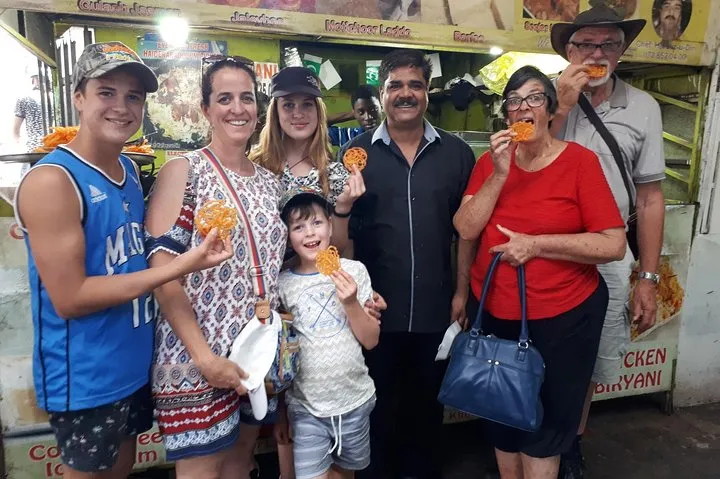 from $78
Joburg street food tour in it's oldest suburb!
Eat through Fordsburg, the city's oldest suburb, one street-food counter at a time.
Check Availability from $43
Soweto: Walking Tour with a Local Guide and Lunch
Walk Soweto's streets with a local resident, eat where the neighbourhood eats; the most honest two hours you can buy there.
Check Availability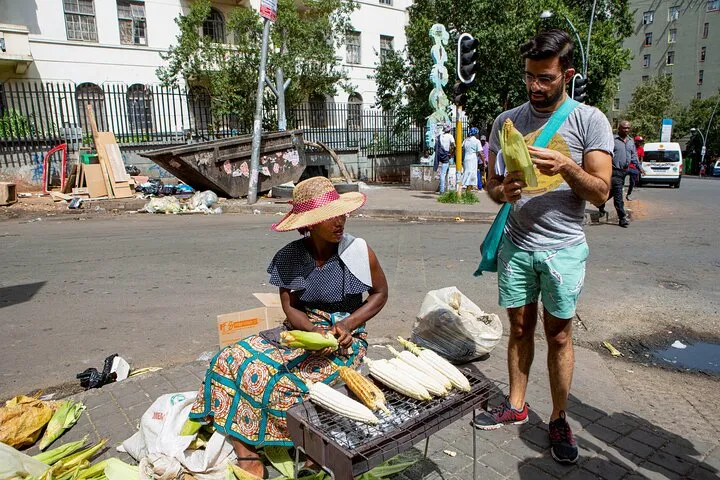 from $50.18
This is Hillbrow
Hillbrow with a guide from the neighbourhood: the tower views and the real story of the city's tallest density.
Check AvailabilityPrices, ratings and details are the platform's own. dollar figures are the listed prices — the platform bills in your account's currency.
The braai, and why it books your Sunday
The braai is not a dish, it is the city's social machine: meat over coals, cooked by whoever owns the tongs, attended by everyone else. In Johannesburg it runs from suburban gardens to township stands to the game-farm lawns northwest of the city — Lesedi Cultural Village, an easy half-day out on the R512, serves its version as a Nyama Choma buffet in a 160-seater. For a visitor the practical forms are two: the grill stands of Vilakazi Street on a guided Soweto day, where the lunch stop is the point, and the boerewors roll — the coiled local sausage on a bun — that appears anywhere coals and a weekend meet.
Order of operations for a short stay: let the Soweto walk handle the township braai, and treat every other grill you pass as a bonus rather than a plan. The full dish-by-dish glossary, pap to malva pudding, is on what to eat.
The price reality: printed, chalked, or cash on the grill
South Africa quotes menu prices with the 15% VAT already in them — that is the law of the printed menu, per SARS, so the number you see at a Sandton terrace is the number you pay. The township counters and market stalls play by no such visible rule: portions are priced by chalk and by conversation, nothing publishes a tariff an international reader can check, and this page refuses to invent bands for them. What travels well instead is the payment logic — small notes at counters and stalls, cards at malls — and the tip custom that sits on top of every version: 10–15% in restaurants, 15–20% for exceptional service, a glance at the bill for a service charge before adding one, and small change for the car guards who watch the parking.
For the trip budget, that makes the meal line the most flexible one you have: the same day can end at a printed-menu Sandton dinner or at a grill plate priced by the portion and paid in a single note. The costs page puts both into the per-day maths.
Eating by day: the markets and the counters
Daylight is when Johannesburg's informal eating shines, and the rhythm is weekly. Sunday belongs to Maboneng: the precinct's own site says its busiest day is the one Market on Main draws, and Arts on Main's studios and eateries make the block worth the walk between bites. Every day belongs to Rosebank's Art & Craft Market, trading 09:00 to 18:30 at 50 Cradock Avenue, which pairs with the mall terraces for the calmest lunch on this page. The Braamfontein strip is the museum-day lunch — Constitution Hill's tours run 09:00 to 17:00 daily, and the free Wits Art Museum makes a two-stop morning of the ridge.
One negative finding worth its own sentence: the famous Saturday market of Braamfontein no longer appears on Neighbourgoods' official site, which lists only Cape Town — so any plan built around it should be treated as unconfirmed until the stalls are in front of you. The honest substitute list is on free things to do, which notes what costs nothing and still feeds you.
Eating after dark: the honest rule
The FCDO's line on Johannesburg nights does not have a dinner exception: do not walk after dark, anywhere, and that includes the walk from a Gautrain station to a restaurant. Read practically, it makes the mall terraces of Sandton and Rosebank the default dinner — you are e-hailing to a guarded door either way, so choose the door with the printed menu. Maboneng's restaurant rows work on the same terms: e-hail in, e-hail out, keep the walk between bar and table inside the precinct's lit blocks. What the rule kills is the spontaneous evening wander that a European visitor defaults to; the safety page has the full language and the scam patterns worth knowing.
For the big night out, the city's answer is structured: the nightlife guide covers the amapiano club circuit that runs with transport included, which is how that evening is done.
The meal that pairs with which day
Match the meal to the day's geography and the city shrinks to a workable size. The Soweto day eats twice in Soweto — a grill-stand lunch on Vilakazi Street, handled by the walk with lunch — because the township is 30–40 minutes by car from Sandton and doubling back for dinner wastes the evening. The Ormonde day — Apartheid Museum and Gold Reef City, which lists a dozen dining options on its own park page — eats on site; remember the museum closes Mondays. The Constitution Hill morning eats in Braamfontein, down the ridge, with the Wits Art Museum as the digestif. The Pilanesberg and Cradle days eat on the road: departures start around 06:00, the parks are hours out, and the sensible dinner is the mall terrace nearest the hotel. And the ridge has one evening of its own for the food-curious: Constitution Hill's monthly Time Travel tour, last Friday of the month at R660 ($40.5), prices food and drinks into the ticket — history served as dinner theatre.
The arrival day has its own answer: the Fordsburg walk if it starts hungry at midday, otherwise the nearest mall dinner and an early night. The dish each of these days should include is on what to eat.
After the eating plan
The dishes behind the places
Braai, pap and chakalaka, bunny chow, kota, mogodu and the sweet endings — what each is and where it finds you: what to eat in Johannesburg. Or return to the Johannesburg city guide.
The dish listThe Soweto day
Vilakazi Street, the Hector Pieterson Memorial and the towers, with the practicalities: the Soweto guide.
Lunch is built inThe guided night out
The amapiano circuit with transport included, reviewed honestly: Johannesburg nightlife.
The after-dark exceptionWhere to eat in Johannesburg: questions
What food is Johannesburg famous for?
The grill culture first — braai, boerewors rolls, pap and chakalaka — then the street formats: the bunny chow and the kota, plus biltong by the bag. Each dish has its own entry on the food page; the places that serve them are the five areas on the mapped list.
What are the most popular restaurants in Johannesburg?
This page deliberately answers by area rather than by venue name: strips and markets outlast single venues, and most of the city's famous tables sit in Sandton's towers or Maboneng's rehabs, both covered above. The one venue-backed rule worth keeping: wherever you book, the after-dark rule decides how you arrive, not the reservation.
Is street food in Johannesburg safe to eat?
The counters that trade daily cook to order at high heat — the grill-and-fry formats of Fordsburg and Soweto turn over stock too fast for it to sit. The honest caution is not the food but the streets around it, which is why the street-food walk exists: the guide carries the local knowledge and the route. Start there, then improvise on your own visit.
How much should I tip in Johannesburg restaurants?
10–15% in restaurants, 15–20% for exceptional service, checked against the bill first — some venues print a service charge. Small tips for car guards and porters are customary. The custom is guidance, not law, and it sits on top of prices that already include the 15% VAT — see the price reality.
Do Johannesburg restaurant prices include VAT?
Printed menus do: South Africa's standard VAT rate is 15% and quoted prices carry it, per SARS. The informal counters and market stalls that price in cash have no printed menu at all, which is exactly why no bands are invented on this page — the money section explains how each format works instead.
Should I book a food tour in Johannesburg?
For a first visit, yes — it is the fastest way into three eating areas in one trip: the Fordsburg walk at $78 for the counters, the Soweto walk at $43 for the township kitchen, or the Hillbrow tour at $50.18 if the neighbourhood story matters more than the tasting. All three are compared on the tours section.
The eating areas on film
Street-level video beats prose for what these areas feel like: the inner city's counters and murals, Soweto's precinct, and the general Johannesburg rhythm a first-time eater should expect.
EXPLORING the BEST of Johannesburg, South Africa Travel Vlog
A food-minded couple's pass through the city, including the market-hall and inner-city eating scene.
Video: Chews to ExploreCulture and history in Soweto Township, Johannesburg, South Africa
The township day as it actually moves — the context that makes the Vilakazi Street lunch make sense.
Video: Mr and Mrs RomanceNEWTOWN, JOHANNESBURG (CBD) CENTRAL
Newtown and the CBD grid at street level — the edge Fordsburg's food counters sit against.
Video: CK6KVideos load from YouTube only when you press play.
Prices, hours and terms are set by the venue or operator and confirmed at checkout.
We may earn a commission if you book through one of our links, at no extra cost to you. Full affiliate disclosure